

In February 2026, criminals stole around €95 million from Fideuram, the private bank of Intesa Sanpaolo, Italy’s largest lender, as Corriere della Sera and Reuters reported on 25 September. They did it with a WhatsApp message, a phone call and an email.
Only one of those three involved AI. The most important detail is that the chairman who approved the transfers did not act on a single message. He looked for confirmation, and he got it. Every confirmation came from the attacker.
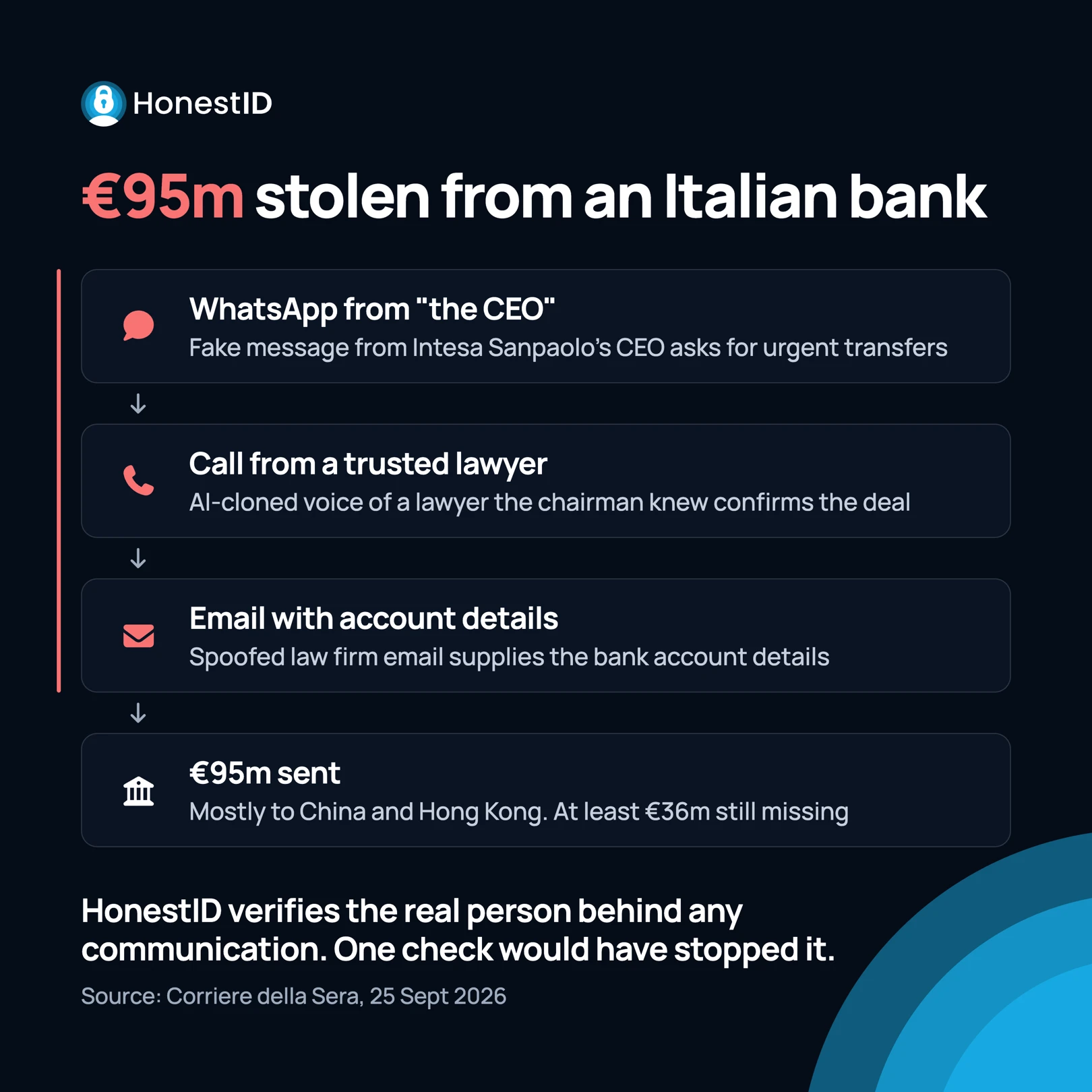
What happened
- The WhatsApp. Paolo Molesini, then chairman of Fideuram, received a WhatsApp message that appeared to come from Carlo Messina, the CEO of Intesa Sanpaolo. It asked for urgent help with a time-sensitive overseas transaction (Gulf News, reporting Reuters).
- The call. A phone call followed from someone who appeared to be Paolo Nastasi, managing partner of A&O Shearman in Italy and a lawyer Molesini already knew. He confirmed the deal. The voice had been replicated with AI tools (Open). Nastasi had nothing to do with it. His voice was used without his knowledge.
- The email. Emails made to look like they came from the law firm then supplied the names of the foreign companies and the accounts to pay (Il Giornale).
- The transfers. On the chairman’s instruction, the bank’s CFO made the transfers through Fideuram’s treasury (Il Giornale). The money went mostly to accounts in China and Hong Kong.
Where the money went
Fideuram’s internal controls raised the alarm, and the bank moved quickly to recover what it could (Il Post).
Sent abroad, mostly to China and Hong Kong.
Recovered, through Italian, Chinese and Portuguese authorities.
Still missing, converted into cryptocurrency.
Of the recovered money, a Chinese bank returned more than €40 million and around €13 million was seized in Portugal (Open). The figure for what is still missing varies by source: Reuters says about €36 million, while court documents reported by Il Sole 24 Ore put it at €39.5 million.
Milan prosecutors have placed a foreign national living outside Europe under investigation on suspicion of computer fraud. Neither Molesini nor any other Fideuram executive is under investigation. Molesini stepped down as chairman in March, citing personal reasons. Intesa Sanpaolo and Fideuram declined to comment.
He did check
It would be easy to read this as a chairman who believed a WhatsApp message. That is not what happened.
He got a request from the CEO. Then he got confirmation from a senior lawyer he knew personally, by voice. Then he got the paperwork from that lawyer’s firm. Three different channels, three different apparent senders, one consistent story.
Most security training tells you to do exactly this: confirm the request on a separate channel. The FBI has given that advice on payment fraud since 2015. Molesini did confirm on a separate channel, with a voice he knew.
The problem is where each check went. Every one of them was answered by the same attacker. When the story matches across every channel, it feels like proof. Here it was just one attacker in three places.
This is the pattern behind most large impersonation losses. In 2024, Arup lost $25 million after an employee joined a video call where everyone else, including the CFO, was a deepfake. The employee had doubts about the original email. The call settled them, and the employee made the transfers.
Only one channel needed AI
The headlines are about the cloned voice, and it matters. A familiar voice is what turned a suspicious message into a trusted instruction.
But look at the other two channels:
- The WhatsApp message needed a phone number and a profile name. No AI.
- The email needed a lookalike address and the right formatting. No AI.
Deepfake detection would have had nothing to look at in either of them. Plain text carries no artefacts. Even on the call, a detector would have to win against a voice that was good enough to convince someone who knew the real person.
Impersonation is not a deepfake problem. It is a problem of not knowing who is on the other end, and it is the same problem on every communication channel.
What would have stopped it
The missing step was simple: asking the real person, somewhere the attacker could not answer.
With HonestID, Molesini could have sent a challenge to the real Carlo Messina, on his own registered phone, before acting on the WhatsApp. Or to the real Paolo Nastasi during the call. Either one takes a few seconds.
- It runs on a separate channel. The challenge goes through HonestID, not through WhatsApp, the phone line or the email thread. An attacker who controls the conversation cannot reach it.
- It reaches the real person. The account is bound to one phone and checked with biometrics. A stolen number or a cloned voice is no use without that phone.
- It carries the context. The real Messina would have seen exactly what he was being asked to confirm: an urgent overseas transfer. He would have denied it, and he would have known straight away that someone was using his name.
- Silence is an answer. On a live call, the real person has no reason not to respond. If no one approves, you have your answer.
Any one of those three checks would have exposed the fraud before a single euro left the bank.
Attackers no longer send one fake message. They build a story across WhatsApp, calls and email, and they make every part of it match. A check on any of those channels just reaches the attacker again.
You can no longer trust the channel. You have to verify the person.